
The Tale of Two Jinnahs
The story of love, politics and the price of ambition.

A few days ago, I picked up "Shattered Lands" by Sam Dalrymple, a book about how the massive Indian Empire, which once included India, Pakistan, Bangladesh, Burma, Yemen, Oman and a few other countries, split into separate nations through five brutal partitions.
Sounds like heavy stuff, right? But Sam's writing has some sort of magic that keeps you going. I've been listening to the audiobook on my evening walks with my dog, and I'd definitely recommend picking this one up.
Anyway, somewhere in the first chapter, Sam mentions something that made me pause mid-walk.
Muhammad Ali Jinnah, the founder of Pakistan, was once so madly in love that he defied society, religion and family to marry a teenage Parsi girl.
Wait, WHAT?
I’ll be honest - most of what I know about Jinnah comes from pop culture and the occasional history documentary. In my mind, he was this uncompromising, stern figure. Always impeccably dressed in his perfect suits, well-spoken, brilliant political mind, but also emotionally distant and pretty intimidating. He was the kind of man who seemed to be married to his principles rather than capable of being swept away by love.
So when I heard that this Jinnah (the same guy who would later fight with relentless determination for Pakistan) had once thrown everything away for love, I was completely baffled.
I had to know more. And what I discovered was a story that reads like a Bollywood tragedy. It's a story that shows how the very passion that made Jinnah fight for love eventually drove him to fight for a nation.
This is the story of two completely different men who happened to share the same name: Muhammad Ali Jinnah.
A quick note: I'm not a historian, nor do I claim to be one. The story below was pieced together after reading various articles and drawing on my perception of these characters from books, documentaries and pop culture. I might get some details wrong, and some of you might not like my simplifications. But my intent here isn't to give you a history lesson. It is to tell you a love story that happens to be true.
Muhammad Ali Jinnah was a man who owned countless perfectly tailored three-piece suits, chain smoked his way through court sessions and maintained a small, exclusive social circle that most people found him intimidating.
By 1916, at the age of 39, Jinnah had already made quite a name for himself in Bombay. He was one of the city’s most successful lawyers and a rising political star. He rarely smiled in public, spoke with a precise English accent and had a reputation for being so formal that even his close friends addressed him as “Mr. Jinnah.” He was the kind of man who would rather spend his evening with colleagues discussing cases, or with political leaders discussing strategy.
He was a key figure in both the Indian National Congress and the All-India Muslim League, working tirelessly toward the dream of getting Hindus and Muslims to work together for independence from the British. He was an “ambassador of Hindu-Muslim unity” and he took that title seriously.
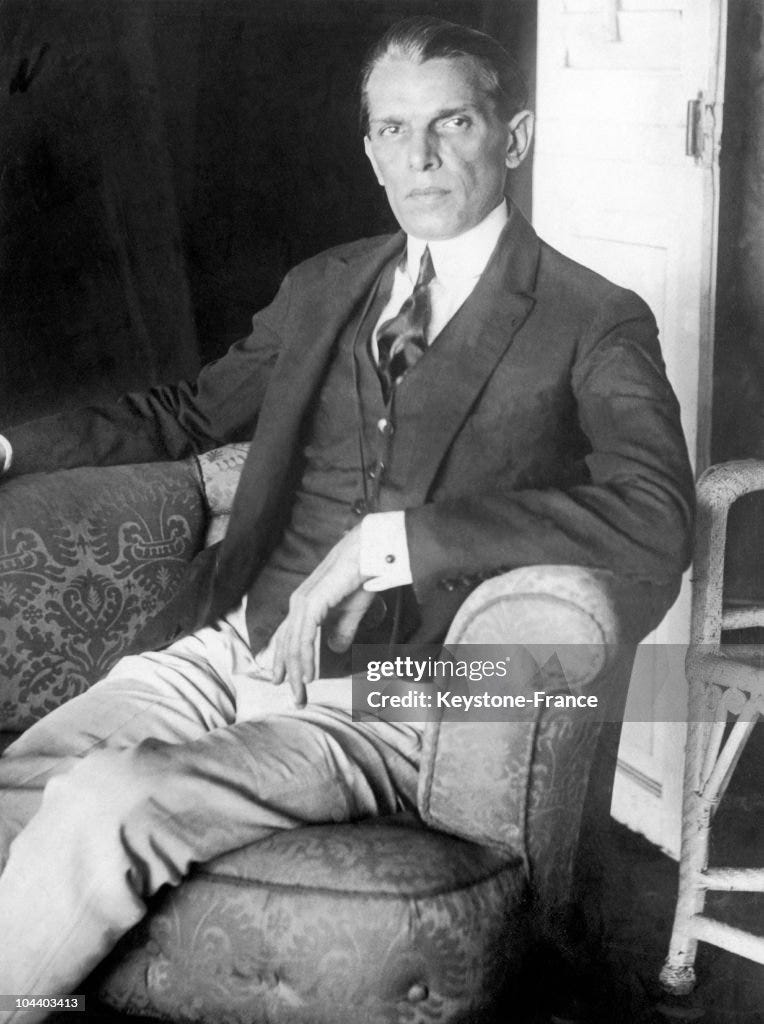
His work was everything to him and he lived a solitary life. He preferred the quiet company of his law books instead of social gatherings. At 39, he remained single (his first wife from an arranged marriage had died years back), and most people assumed he’d never marry again.
Among his close friends was Sir Dinshaw Petit, one of Bombay’s most influential businessmen. Both men moved in the same elite circles, shared an interest in politics, and were part of Bombay’s influential crowd. So, when Sir Dinshaw invited Jinnah to escape Bombay's brutal summer heat by joining his family in the cool hills of Darjeeling, Jinnah gladly accepted.
And that’s where he met a 16 year old Ruttie Petit.
Ruttie was Sir Dinshaw’s daughter, and people often called her “The Flower of Bombay” - beautiful, intelligent and the kind of person who could make any room feel more alive by just walking into it. She was well-read, politically curious and fearless in ways that both charmed and occasionally scandalized society.
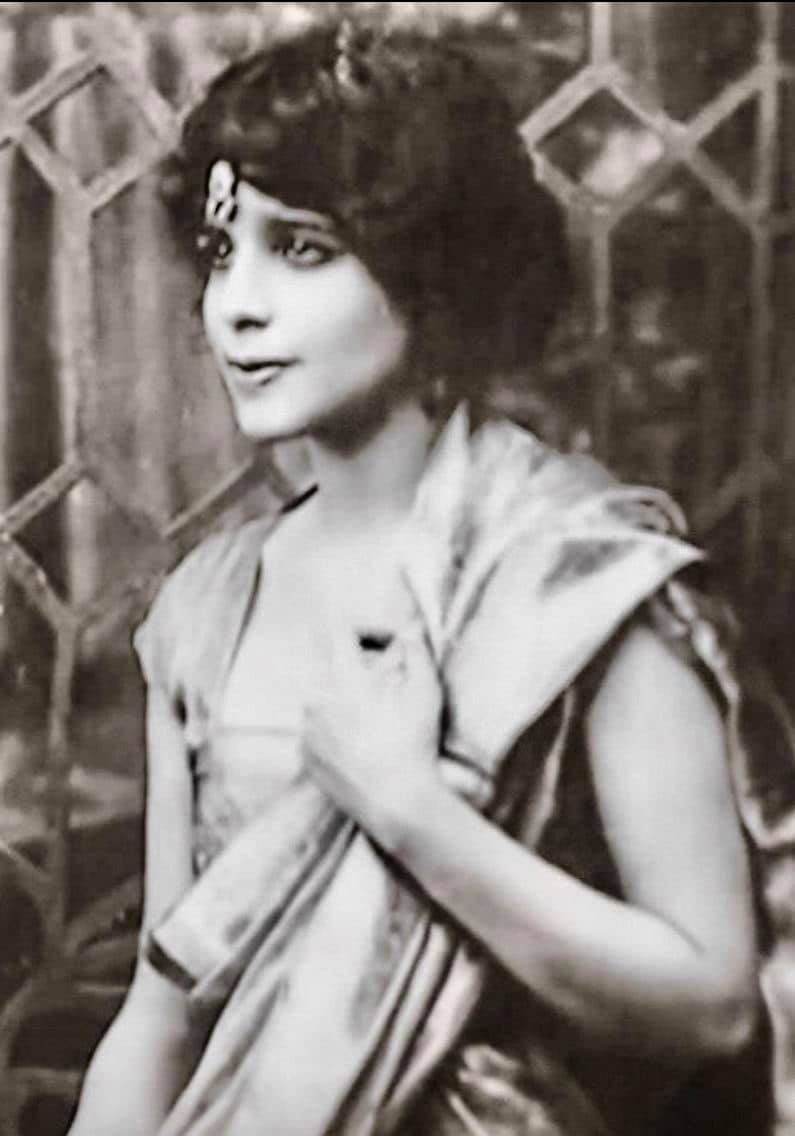
Now you’d think that a 39 year old lawyer and a teenage girl would have absolutely nothing in common. But somehow, Ruttie didn’t see Jinnah as just another friend of her father’s. His sharp wit, his passion for politics, and even his perfectly ironed suits made her curious about this distinguished man who seemed so different from everyone else in her social circle. And for Jinnah, meeting Ruttie was like discovering colour in a black and white world.
Over those summer weeks in Darjeeling, something magical happened. They spent their days horse riding through the hills and their evenings talking for hours about books, politics and life. For the first time in years, Jinnah was actually laughing. Not just smiling, but genuinely laughing.
For Ruttie, Jinnah was unlike anyone she’d ever met. He didn’t treat her like a child or dismiss her opinions because of her age. He listened to her thoughts about politics, recommended books and engaged with her ideas with the same seriousness he would show a fellow lawyer. She was fascinated by his worldliness, his elegant mannerisms and his passion for justice and independence.
By the end of the summer, the 39-year old lawyer, and the carefree teenager had formed a connection that made perfect sense, even when it made no sense at all.
When they returned to Bombay, Jinnah approached Sir Dinshaw Petit and asked for his daughter’s hand in marriage. Sir Dinshaw was shocked. The idea of his teenage Parsi daughter marrying a nearly 40-year old Muslim man was absurd. He immediately forbade Ruttie from meeting Jinnah and made it very clear that Jinnah was no longer welcome in their home. He even got a court order to keep him away from Ruttie.
But they were in love. Truly, madly in love. For two years, they kept their romance alive by meeting in secret, exchanging passionate letters and absolutely refusing to bow to her father’s demands.
On February 20, 1918 (Ruttie’s 18th birthday), she finally came of age. Within weeks, she had converted to Islam, left her father’s house and married Jinnah in a small ceremony. Only a handful of close friends attended but not a single member of Ruttie’s family was present.
The media called it “the marriage that shook India”. And it really did. As it was not just an interfaith marriage, it was a complete defiance of age, religion, social hierarchy and family. Ruttie was immediately banished from the Parsi community, cutting her off from the only world she had ever known.
But neither Jinnah nor Ruttie seemed to care about any of it. They had fought the entire world for this, and were now married to the person they loved. That was all that mattered.
The first few years of their marriage were magical.
Jinnah, who was known to be a workaholic, suddenly became a man in a hurry to get home. He would rush out of court sessions and skip his usual chess and billiards sessions with colleagues, so that he could spend his evenings with Ruttie.
Friends watched him change as a person. The stern, formal lawyer they knew had been replaced by someone who actually seemed... happy. Joy and laughter had finally entered Jinnah's world.
Ruttie, who called him “J” or “Jay”, had a unique ability to bring out sides of him that no one else had ever seen. They became one of Bombay’s most talked about couple. They were often spotted driving down Marine Drive in Jinnah’s fancy convertible, with Ruttie’s long hair blowing freely in the breeze, and Jinnah at the wheel in his perfect suit, smiling.
But Ruttie was never going to be just a beautiful wife who stayed quietly in the background. She was a fearless woman, and proved it dramatically by climbing onto a balcony Bombay’s townhall, when she was five months pregnant. “We are not slaves,” she shouted at the colonial police trying to disperse the crowd.
Jinnah adored this fearlessness of her. At a formal dinner, when the governor's wife passive aggressively suggested getting a shawl for Ruttie's "revealing" dress, Jinnah responded by saying, "when Mrs. Jinnah feels cold, she will say so and ask for a wrap herself."
In August 1919, Ruttie gave birth to a daughter, on the midnight of August 14-15, exactly 28 years before Pakistan’s creation. Though, of course, no one could have known the significance of the timing back then.
It seemed like they had everything they needed - love, family, success and a future full of possibilities. But in 1920, something began to change.
By 1920, Mohandas Gandhi had fully entered India’s political scene with a revolutionary call for a mass civil disobedience movement. His approach resonated with millions of Indians, but Jinnah disagreed with his methods. As a lawyer who believed in constitutional methods, he thought Gandhi’s approach was dangerous.
At a meeting of the Indian National Congress in September 1920, Jinnah argued that rushing into this movement would lead to chaos. The session turned hostile and probably for the first time in his career, Jinnah, a brilliant orator, was shouted down by the crowd. He was even mocked for calling Gandhi “Mr. Gandhi” instead of “Mahatma”. The elite lawyer in his perfectly tailored suit suddenly looked out of place with the crowds singing Gandhi‘s bhajans.
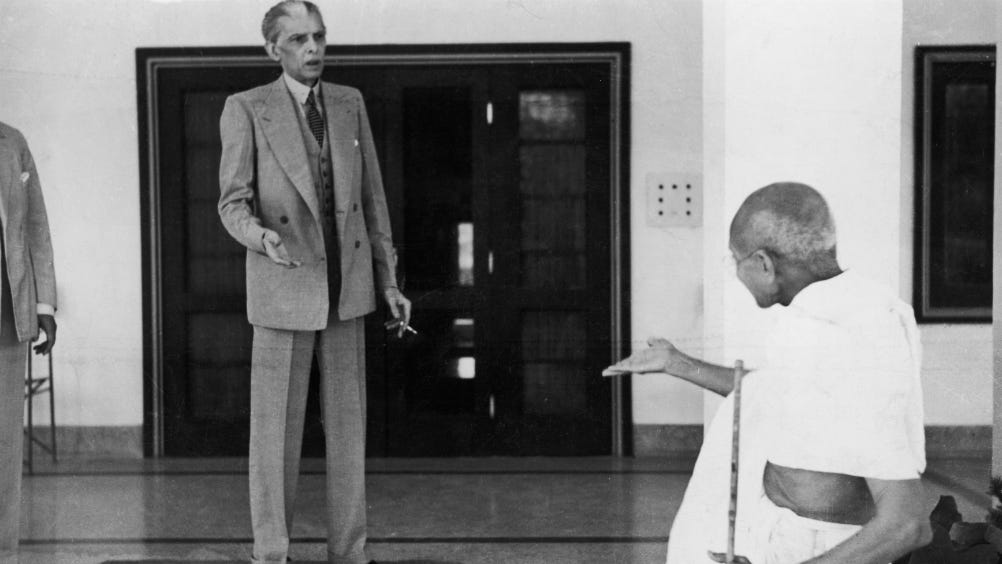
For Jinnah, this public humiliation was devastating. By late 1920, he resigned from the Indian National Congress, unwilling to support Gandhi's approach. But this stance left him isolated. The man who had once been called the "ambassador of Hindu-Muslim unity" was now just a politician without any support.
But it was Ruttie who would pay the heaviest price for her husband's wounded pride.
At first, the change was subtle. Ruttie noticed that their evening conversations started getting interrupted by political visitors. The romantic Marine Drive drives became less frequent. Jinnah would come home from meetings looking frustrated and would mostly be lost in thoughts about political strategy rather than focused on their life together.
As months passed, the distance between them became impossible to ignore. The man who used to rush home after court sessions to spend hours talking with Ruttie was now consumed with rebuilding his political career. He threw himself into reviving the Muslim League, spending weeks away from Bombay on political tours across India.
The evenings that used to belong to Ruttie now belonged to strategy sessions with party leaders. The passion that had once been focused entirely on winning her love was now directed at staying politically relevant.
Meanwhile, Ruttie found herself mostly alone in their Bombay house. She was still in her early twenties - young, energetic and wanting some excitement. But Jinnah was always somewhere else. Even when he was home, his mind was on political battles and the task of keeping the Muslim League alive in the age of Gandhi.
What made it worse for Ruttie was that she had given up everything for their love. Her family still refused to speak to her. The Parsi community had completely shut her out. The glamorous social circles she had once moved in were largely closed to her. Jinnah had been her entire world, and now, that world was shrinking.
The stress affected both of them in different ways. Even their daughter remained nameless for months after her birth because both parents were too distracted. Jinnah was consumed with his politics, while Ruttie struggled with loneliness and the growing realization that her husband's ambitions might always come before their marriage.
By 1922, even Ruttie’s close friends could see that something was wrong with her. Ruttie, who had once been the life of every gathering, started having mood swings. She began confiding to her close friends (particularly the poet Sarojini Naidu and her daughters), that she felt like she was "losing her youth" and needed to "live" before it was too late. The woman who used to light up every room was slowly fading away.
In 1925, feeling suffocated in Bombay, Ruttie decided to travel alone (without Jinnah, or her baby, who was finally named ‘Dina’) to Hyderabad to visit her friends. It was an act of rebellion, a cry for attention and perhaps a test to see if her husband would fight for their marriage the way he once fought for her hand.
But Jinnah, bound by pride, didn’t stop her.
When she returned after a few weeks, their life resumed. But something between them had changed. Maybe the trip showed them both how far apart their worlds really were.
As years went by, things got worse for Ruttie. She started using morphine and other drugs to deal with depression, the pain of watching her marriage fall apart and a mysterious illness that the doctors couldn’t properly diagnose or treat.
By 1927, their marriage was basically over. They still lived in the same house but like strangers. Jinnah knew that he had failed as a husband, but he was too consumed with the political battles around him to do anything meaningful about it.
In 1928, Ruttie moved out with their 8 year old daughter, Dina, to a suite at the Taj Mahal Hotel in Mumbai. They were officially separated now, though they never got divorced.
Over the next few months, Ruttie’s health got worse. She was only 27 but looked much older because of her illness and all the emotional pain she had been through. She spent most of her time bedridden in her suite at the Taj Hotel.
For the first time since her marriage, her parents finally stepped in to help. Sir Dinshaw and his wife couldn’t watch their daughter suffer any longer. They took Ruttie and little Dina to France hoping that the doctors there might be able to help.
While she was there, her condition got so bad that she fell into coma. When Jinnah heard how serious it was, he dropped everything and rushed to France. For days, he sat beside her as she fought for her life.
Somehow, Ruttie pulled through. She recovered enough to talk and even spend some quiet time with Jinnah. But when Ruttie was well enough to travel back to India, Jinnah didn’t come with her. Whether it was because of work commitments or because he thought she needed space, he stayed behind. Ruttie made the journey home knowing, that perhaps, that this was the end.
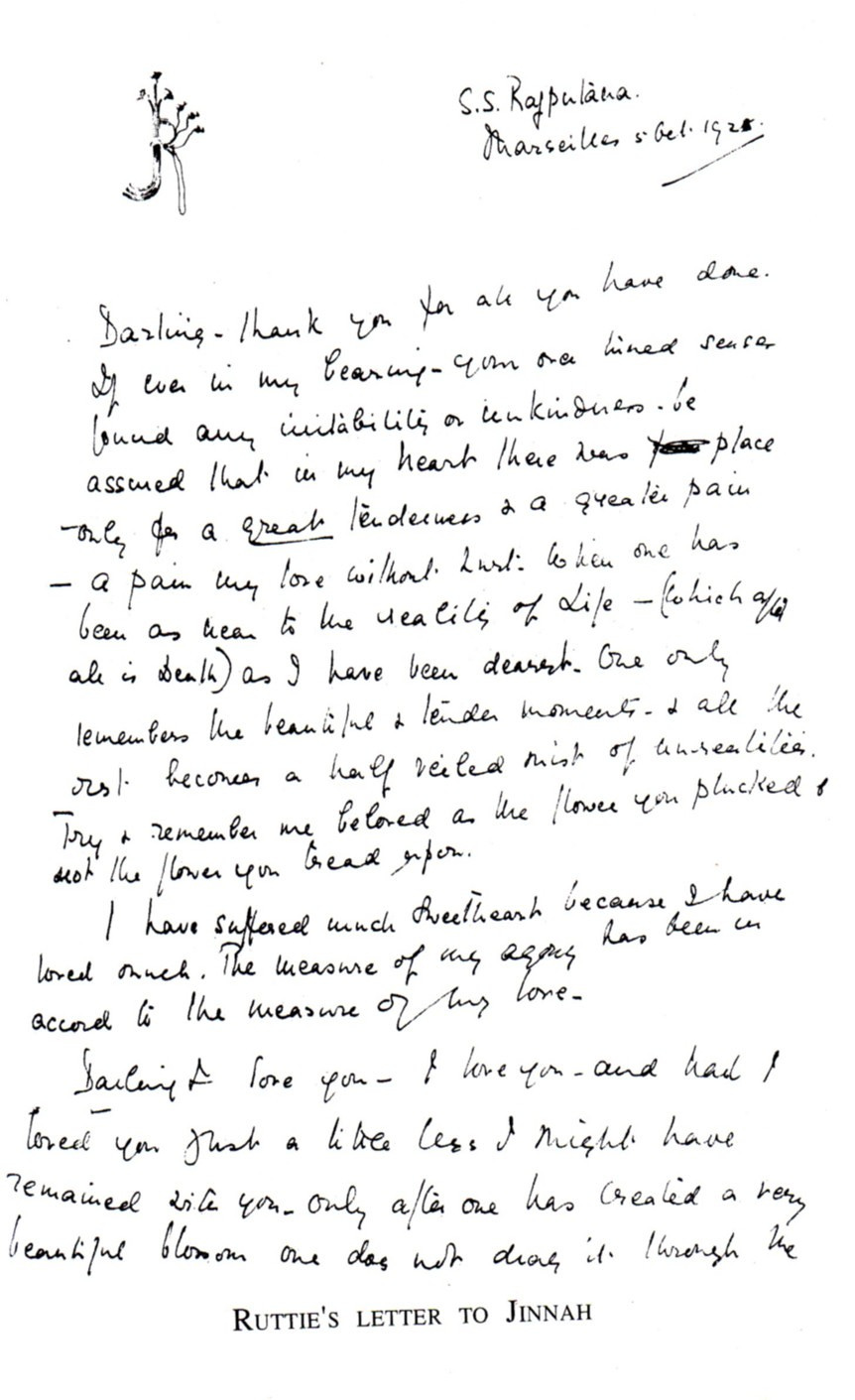
On her way back to India, she wrote to Jinnah what would be her final letter:
Darling, thank you for all your have done. When one has been as near to the reality of life (which after all is death) as I have been dearest, one only remembers the beautiful and tender moments and all the rest becomes a half veiled mist of unrealities. Try and remember me beloved as the flower you plucked and not the flower you tread upon.
Darling I love you, I love you - and had I loved you just a little less I might have remained with you…
I have loved you my darling as it is given to few men to be loved. I only beseech you that the tragedy which commenced in love should also end with it.
Back in Bombay, Ruttie’s condition deteriorated quickly. She was still living at the Taj Mahal Hotel, and was so weak that she could barely speak.
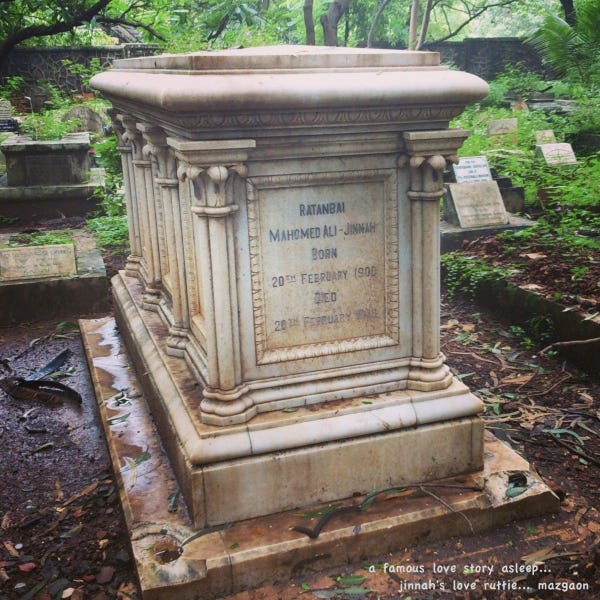
On February 20, 1929 (her 29th birthday), Ruttie died in her hotel room. The exact cause of her death was never really clear. Officially, it was cancer, but given her morphine use and her state of mind, some people suggested that she had slowly killed herself. Years later, her daughter Dina revealed that her mother had committed suicide.
However she died, one thing was certain, Ruttie had died of a broken heart as much as a broken body.
At her funeral, Jinnah sat beside the grave like a statue. Not a single tear, just that familiar blank stare that everyone knew. Then came the moment when he was handed the bowl of earth to scatter on Ruttie's grave.
The bowl slipped from his hands and he broke down completely. Tears streamed down the face of a man who had built his entire reputation on never showing weakness. It was the first time anyone had ever seen Jinnah cry in public.
Jinnah spent the rest of his life living with his sister Fatima for company. Those close to him said that was “never the same” after Ruttie’s death. He threw himself completely into politics. The same intensity and passion that had once made him fight for Ruttie’s love was now entirely focused on creating Pakistan.
In August 1947, as Jinnah prepared to leave Bombay forever to become Pakistan's first Governor-General, he made one last visit to Ruttie's grave. Many years had passed since that tearful funeral, but time had not healed anything. Those who were with him saw tears in his eyes again. Only the second time anyone had witnessed him cry publicly.
It was a moment of irony. Jinnah was about to achieve his greatest political victory, becoming the father of a new nation. But, he was leaving behind two pieces of his heart, his daughter Dina, who had chosen to stay in India, and Ruttie, who rested forever in her Indian grave.
The man who fought the entire world for love was now leaving behind the only two people he had ever truly loved, on the wrong side of the border that he had created.
In her final letter, Ruttie had asked him to remember her as "the flower you plucked." Standing at her grave in 1947, maybe Jinnah finally understood what she meant.
Some flowers, once picked, are meant to be cherished in the moment and not left to wither while you chase other dreams.
Very well written!
Nicely written! You are right that he was married to the cause of Pakistan - he only dedicated himself to it after Ruttie's death. And Dina's date of birth is so intriguing isn't it - she was born at midnight between the independence days of India and Pakistan - though she was the daughter of Pakistan's founder, she chose to stay in India - but she was in the middle of both in away, like her date of birth. Dina said she saw her father cry on two occasions - when Ruttie died, and when he last visited Ruttie's grave in Bombay before leaving for Pakistan! 💕